How to Change a Flat Tire: A Complete Step-by-Step Guide
A flat tire always seems to happen at the worst time. One study shows howtochangeatires.com alone responds to more than 3.5 million flat tire calls every year in the U.S., so if it hasn’t happened to you yet, there’s a good chance it will.
The good news? Learning how to change a flat tire takes less than 30 minutes once you know the steps. In this guide, you’ll learn exactly how to change a car tire safely, what tools you need, and what most guides forget to mention like why your spare might not even be a spare, and why you should check your lug nuts again after driving.
Before You Even Have a Flat: Check What’s in Your Trunk
Here’s something most guides skip: not every car has a spare tire anymore.
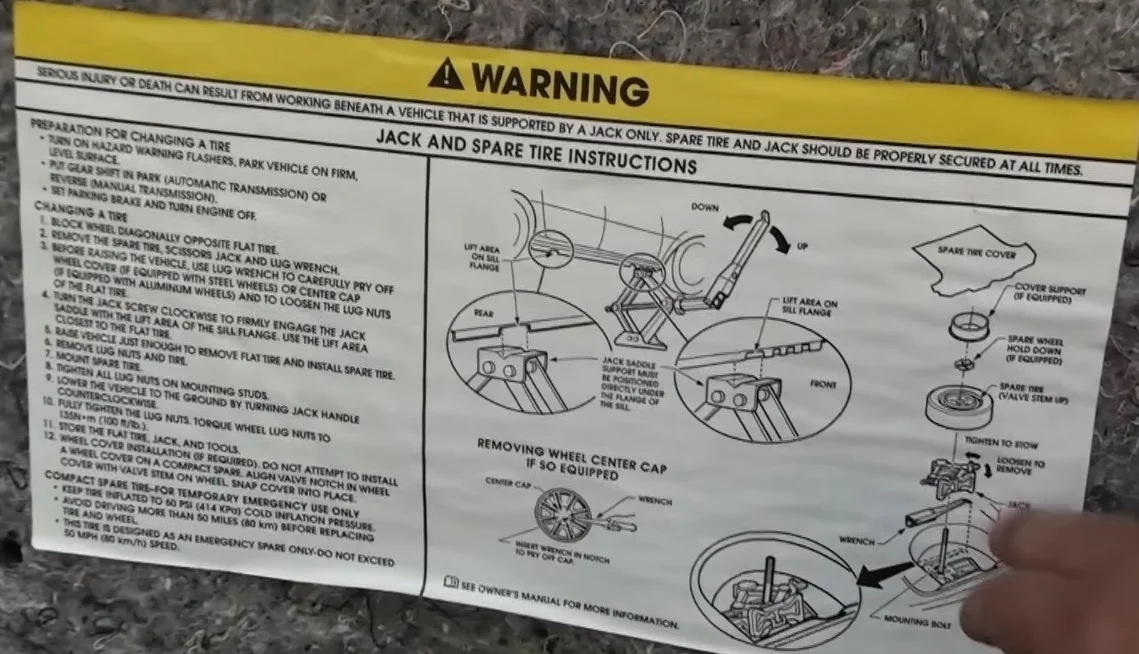
In recent years, many automakers have replaced the traditional spare with either a repair/inflator kit or run-flat tires. Each option works differently:
- Full-size or compact spare tire – A real wheel and tire you swap in, following the steps below.
- Repair/inflator kit – A can of sealant and a small air pump. Works for small tread punctures but usually can’t fix tire sidewall damage or a blowout.
- Run-flat tires – Built to keep you driving a limited distance (often 50 miles) after a puncture, giving you time to reach a tire shop or mechanic without stopping.
Check your trunk today, not during an emergency. If your car lacks a spare, jack, and lug wrench, you can buy a compatible set separately.
Tools You Need for Changing a Tire Step by Step
Most cars store these basics in the trunk or under the cargo floor:
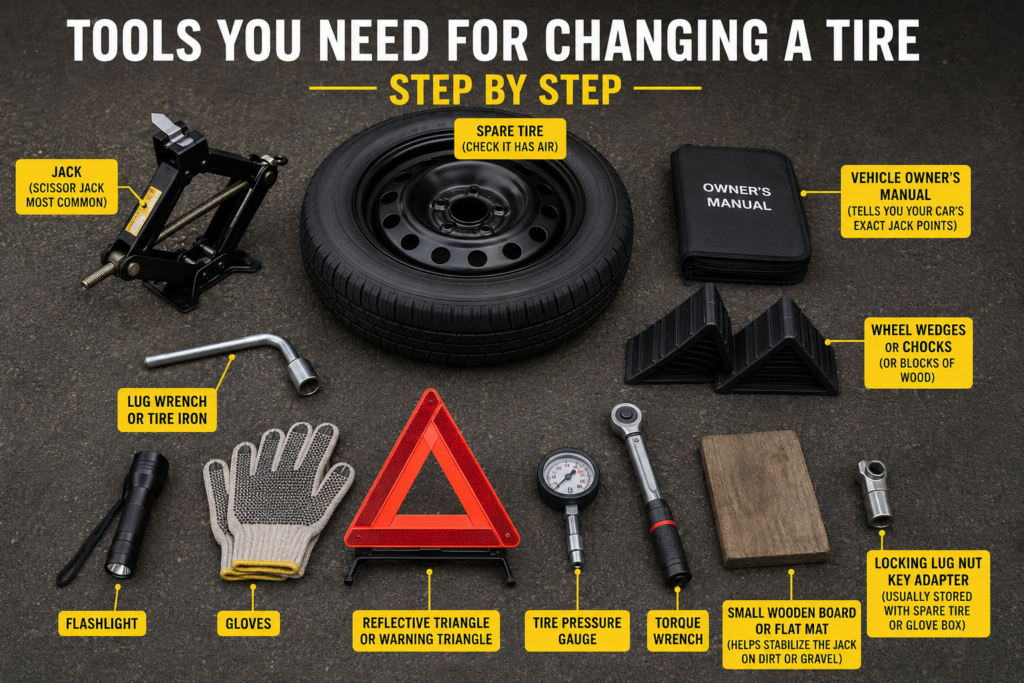
- Jack (scissor jack is most common; some trucks and SUVs use a hydraulic jack)
- Lug wrench or tire iron
- Spare tire (check it has air before you need it)
- Vehicle owner’s manual — this tells you your car’s exact jack points, which vary by vehicle make and model (SUV, sedan, or truck)
- Wheel wedges or chocks (or blocks of wood in a pinch)
It’s also smart to keep these in your emergency roadside kit:
- Flashlight
- Gloves
- Reflective triangle or warning triangle
- Tire pressure gauge
- Torque wrench
- A small wooden board or flat mat (helps stabilize the jack on dirt or gravel)
If your wheels have locking lug nuts, you’ll also need the matching key adapter it’s usually stored with the spare tire or in the glove box. Losing track of this small piece is a common reason people get stuck.
Step 1: Pull Over Safely
The moment you feel a flat tire on the road, resist the urge to keep driving fast.
- Ease off the gas gently; sudden braking or steering can make a blowout worse.
- Turn on your hazard lights immediately, even during the day.
- Steer toward flat, level ground a parking lot, wide shoulder, or side street is best. Avoid curves, blind spots, and soft grass or dirt.
- Shift to Park (or first gear for manual transmissions) and set the parking brake.
- Place wheel wedges or chocks against the tires on the opposite side of the flat.
- Set up your reflective triangle behind the car on faster roads, place it further back, since cars cover ground quickly at highway speed.
This is where most roadside safety mistakes happen not during the actual tire change. If you’re stuck somewhere you can’t safely pull over, like a narrow bridge, it’s okay to roll slowly on the flat until you reach a safer spot, even though it may damage the wheel further.
Step 2: Gather Your Tools and Prepare the Car
- Pull out the spare tire, jack, and lug wrench. On some trucks, minivans, and SUVs, the spare is mounted underneath the vehicle and needs to be lowered with a separate tool check your manual.
- Remove the hubcap or wheel cover, if there is one, using the flat end of the lug wrench or a screwdriver.
- Lay down your board or floor mat if you’re kneeling on dirt or gravel it keeps the jack (and your knees) steady.
Step 3: Loosen the Lug Nuts
This step happens while the tire is still touching the ground not after the car is jacked up.
- Turn each lug nut counter-clockwise with the lug wrench, about a quarter turn each, just enough to break resistance.
- Don’t remove them yet.
- If a nut won’t budge, stand on the wrench and use your body weight rather than just your arms.
Loosening lug nuts on the ground gives you traction and control that you lose once the car is in the air.
Step 4: Jack Up the Car
- Check your owner’s manual for the correct jack point, usually a reinforced spot on the frame, marked with a notch.
- Slowly raise the jack until the flat tire is about 6 inches off the ground.
- If the car feels unstable at any point, lower it and reposition the jack before continuing.
Jacking up the car on soft or uneven ground is one of the biggest safety risks. Never place any part of your body underneath the vehicle while it’s raised; the jack lifts the car, but it isn’t designed to hold your weight if it slips.
Step 5: Remove the Flat Tire
- Finish unscrewing the loosened lug nuts by hand.
- Set them somewhere they won’t roll away an upturned hubcap works well as a tray.
- Grip the tire with both hands and pull it straight toward you to slide it off.
Removing the flat tire is usually simple once the lug nuts are out of the way.
Step 6: Mount the Spare Tire
- Line up the spare’s holes with the wheel bolts.
- Push the spare flush against the wheel base.
- Screw the lug nuts back on by hand, turning clockwise, until snug.
Avoid using the lug wrench to fully tighten the nuts while the wheel is still in the air — the extra force can knock the car off the jack.
Step 7: Tighten in a Star Pattern
Don’t tighten lug nuts in a simple circle it seats the wheel unevenly.
Instead, use a cross pattern lug nut sequence (also called tightening lug nuts in a star pattern):
- Tighten one nut, then move to the one directly across from it not the one next to it.
- Keep alternating in this star shape until every nut is snug.
This spreads pressure evenly so the wheel sits flush against the hub.
Step 8: Lower the Vehicle and Finish Tightening
- Slowly lower the jack until the spare touches the ground but isn’t carrying the car’s full weight yet.
- Finish tightening each lug nut as hard as you safely can, still following the star pattern.
- Lower the jack completely and remove it, along with the wheel chocks.
- Give the lug nuts one final pass with the wrench.
If you carry a torque wrench, tighten to the exact torque specifications in your owner’s manual this keeps the wheel from working loose later. Many people skip this step, but it matters more than it seems.
Step 9: Check Tire Pressure and Pack Up
- Use a tire pressure gauge to confirm the spare has enough air. Most compact spares need 55–60 psi, but check your manual for the exact number.
- One detail people often get wrong: the correct tire pressure is listed on a sticker inside your driver’s door jamb, not the number printed on the tire’s sidewall. That sidewall number is the tire’s maximum rating, not the recommended pressure.
- Load the flat tire, jack, and tools back into the trunk.
- Pick up your reflective triangle and pull safely back into traffic.
Drive a few miles, then stop and re-tighten the lug nuts one more time. New connections settle after the first few minutes of driving, and this quick recheck catches anything that loosened.
Understanding Your Spare Tire
Not every spare is built the same. Spare tire types generally fall into two categories:
- Full-size spare – Matches your regular tires and can be driven normally, without mileage or speed limits.
- Compact “donut” spare – Smaller and lighter, meant only for short trips, generally under 50 miles and below 50 mph.
If you’re driving on a donut, get to a tire shop that day or the next. Also check your manual before mixing a brand-new tire with three worn ones for all-wheel-drive vehicles especially, this mismatch can affect handling.
When to Call Roadside Assistance Instead
Sometimes the safest move is not to change the tire yourself. Call roadside assistance AAA, your insurance’s roadside service, or your car manufacturer’s program if:
- You’re on a busy highway with no safe place to pull far off the road
- The lug nuts won’t loosen even with full effort or a locking key adapter you can’t find
- You only have a repair/inflator kit and the damage is a tire blowout or sidewall tear, which those kits can’t fix
- Weather (heavy rain, ice, darkness) makes it unsafe to work outside
- You’re waiting for help in that case, stay off to the side of the road, not in front of or behind the car, and never sit inside it if you’re near moving traffic
There’s no shame in calling for help. Practicing the steps in your driveway ahead of time with plenty of open space makes you far more confident if it happens for real.
Common Mistakes to Avoid
- Loosening lug nuts after jacking up the car instead of before
- Parking on soft dirt, grass, or an incline
- Skipping the parking brake or wheel chocks
- Tightening lug nuts in a circle instead of a star pattern
- Trusting the tire’s sidewall number instead of the doorjamb sticker for air pressure
- Driving a donut spare too far or too fast
- Forgetting to re-tighten lug nuts after a few miles
- Never actually checking whether your car has a spare until you need one
FAQ’s
1. How long does it take to change a flat tire?
Most people finish in 15–30 minutes once they know the steps. It’s faster with practice.
2. Can I drive on a spare tire long distance?
A full-size spare handles normal driving. A compact donut spare should only go about 50 miles at speeds under 50 mph.
3. What if my car doesn’t have a jack or spare?
Some newer cars only include a repair/inflator kit. If yours has neither and you can’t fix the flat, call roadside assistance.
4. Is it safe to change a tire on the highway?
Only if you can pull the car well off the roadway onto flat, level ground. If not, stay inside with hazard lights on and wait for help rather than working next to moving traffic.
5. Why do I need to re-tighten lug nuts after driving?
A newly mounted wheel can settle slightly in the first few miles. Checking and re-tightening ensures the lug nuts stay fully secure.
Final Thoughts
Knowing how to change a flat tire turns a stressful roadside moment into a manageable 20-minute task. The order matters: loosen before you jack, tighten in a star pattern, and always double-check your work, including a second lug nut check after a few miles of driving.
Keep your tools together, check your spare’s air pressure regularly, and don’t hesitate to call for roadside assistance when conditions aren’t safe enough to do it yourself.

Mason Carter is an automotive technician helping drivers master tire maintenance with clear, practical guides. With years of hands-on experience, he breaks down complex tire care into simple, actionable steps for every skill level.
Through HowToChangeATires.com, Mason simplifies complex automotive concepts into clear, actionable guides that empower vehicle owners to take control of their maintenance. Whether you’re a first-time tire changer or looking to refine your skills, Mason’s detailed tutorials and expert tips ensure you have the knowledge and confidence needed for the job.
12 thoughts on “How to Change a Flat Tire”